Today, it’s almost impossible to attend a meeting, browse social media, or network with peers without hearing about AI. From real-world success stories in your industry to suggestions on how you could implement it yourself, the conversation is everywhere. You may even hear claims that AI is essential for staying competitive. Yet many business leaders still ask:
- What does AI in my business look like?
- Will AI integration deliver a return on investment?
- Will it give my company an advantage in the years ahead?
These are valid questions without a single clear answer, but we are here to help guide you.
What is AI?
Artificial intelligence is not a machine version of the human brain — at least, not yet. Instead, it is a set of technologies designed to recognize patterns, process information, and make decisions at a speed and scale that people simply cannot match.
At its core, AI is a system of algorithms designed to process enormous amounts of data with exceptional speed. It improves continually through advanced methods like machine learning, deep learning, and neural networks. Human guidance is necessary to provide accurate training data and to reduce the risk of bias in results.
For organizations, AI in business provides an efficient way to process and interpret the growing volumes of information coming from customers, partners, and internal systems.
What is the Business Case for AI?
As we enter a new era of technology, it is important to understand the advantages of AI and how it might enhance your strategy. While some hesitation around emerging tools is natural, there are many proven ways AI can help improve your business:
- Market Research: AI can gather large datasets and analyze them rapidly. This allows businesses to forecast trends, understand customer behavior, and manage risks. It can also identify unusual patterns that might indicate cyber threats in real time.
- Operational Efficiency: Through AI and machine learning in business, repetitive and time-heavy tasks can be automated. This not only frees teams to focus on higher-value work but also streamlines workflows, reduces mistakes, and adapts processes as the technology learns and updates itself.
- Customer/Employee Relationship: Many decision-makers do not realize that AI in business can enhance both customer and employee interactions. By analyzing user behavior, AI can create personalized product suggestions, deliver targeted marketing, and customize customer service experiences. These capabilities are among the most valuable benefits of A.I. in marketing.
Where Do Businesses Use AI Today?
Understanding the potential of AI is just the first step in deciding if it is right for you. Seeing real examples of AI applications in business can make its value clearer. Below are some practical ways how artificial intelligence helps businesses on a daily basis.

Sales and Marketing
- AI optimizes CRM systems for better customer management.
- AI drives highly personalized marketing campaigns.
- AI increases the accuracy of targeted advertising.
Customer Service
- AI-powered chatbots provide instant responses on websites and apps.
- AI learns from every customer interaction.
- AI uses sentiment analysis to improve service quality over time.
Operations and Supply Chain
- AI enables predictive inventory management.
- AI improves logistics planning for faster delivery.
- AI helps reduce operational costs.
Finance and HR
- AI detects fraud in financial transactions.
- AI supports underwriting processes.
- AI screens resumes quickly and accurately.
IT and Cybersecurity
- AI tools such as AIOps identify IT system issues.
- AI-powered intrusion detection spots threats early.
- AI responds to security risks before damage occurs.
With more companies exploring how to use artificial intelligence in business, generative AI adoption has grown rapidly. From 2023 to 2024, usage doubled with 65% of organizations reporting regular use by late 2024, compared to 33% in 2023. That is a staggering 32% increase according to amplifAI.
What Are the Capabilities of AI?
Like any tool a business adopts, AI comes with specific capabilities and limitations. It is not yet fully autonomous, which means human involvement is still required to make it truly effective. This is not a drawback because the small limitations are outweighed by the powerful ways AI can help CEOs, C-suite leaders, and employees move beyond basic tasks and into advanced high-value work.
At its best, AI can learn, adapt, and apply its knowledge to deliver measurable business outcomes as requested. Above we touched on market research, operational efficiency and customer/employee relationships, but here are some of the core capabilities that go a bit beyond basic tasks:
- Natural Language & Generative AI: Powers content creation, code generation, and advanced language modeling.
- Creates human-like text for marketing, customer service, and internal documentation.
- Analyzes and responds to natural language queries for faster, more accurate communication, ie. advanced chatbots.
- Computer Vision & Document Processing: Enables OCR or optical character recognition and visual automation for faster data extraction and analysis.
- Detects and interprets images, diagrams, and forms to streamline workflows.
What is the ROI for Businesses that use AI?
“Is AI right for my business?” As you read, keep this question in mind. We can’t answer it for you, but we can lay out the facts. Some additional key questions to consider are, “What is the cost of artificial intelligence?” and “Will using AI bring value to my business?”
A Microsoft study indicates that businesses integrating AI into their operations achieve an average return of 3.5 times their original investment. Some industry leaders report even higher ROI, with returns reaching up to 8 times their investment and a 14-month increase in measurable gains after deployment.
It’s no wonder that most CEOs love AI. A recent IBM survey of 3,000 global executives found that 75% of CEOs believe AI adoption creates a competitive advantage, and 50% have already begun integrating the technology. Many anticipate AI will reshape their operations within the next three years.
Key areas driving ROI:
- Revenue Uplift via Marketing & Sales: AI boosts campaign performance by personalizing customer engagement and targeting leads with greater precision, lowering acquisition costs and improving conversion rates. Salesforce research shows companies using AI-driven data analysis in sales and marketing see ROI increases of 15–20%. AI-powered forecasting also provides a competitive edge, improving efficiency and decision-making.
- Quick Wins: AI can deliver quick gains. Conversion rates often rise 15–35%, with some cases reporting up to 67% increases when using AI-powered chatbots.
- Human Resources: AI streamlines recruitment and improves employee retention through automation and personalized learning paths.
- Supply Chain Management: AI enhances transparency and efficiency in supply chains, reducing inventory costs and improving delivery timelines.
AI has helped several companies across different industries, as seen in these real-world examples found in a study from BarnRaisers:
- AstraZeneca: Reduced the time required for drug discovery by 70% using an AI agent to identify potential treatments for chronic kidney disease.
- American Express: Achieved a 25% reduction in customer service costs and a 10% increase in customer satisfaction by implementing an AI-powered chatbot.
- General Mills: Saved over $20 million in transportation costs since the 2024 fiscal year by using AI in its logistics planning.
- H&M: Increased conversion rates during chatbot interactions by 25% and saw a 3x faster response and resolution time using an AI agent for personalized product recommendations and customer queries.
What are the Potential Drawbacks and Risks of AI?
Adopting AI comes with challenges that businesses must carefully consider. Poor data quality, skill gaps, and unethical deployment can limit AIs effectiveness and even disrupt operations. Without proper training and internal buy in, organizations risk harming productivity and reducing the positive impact AI can have on the workforce.
Other potential issues include upfront costs, data privacy, time needed for adjustment, and overdependence on AI. Let’s break these down further.
Upfront Costs and Integration Complexity
Implementing AI requires significant investment and careful integration with existing systems.
- Costs include hardware, software, talent, model development, and ongoing maintenance.
- Integration may require system upgrades or custom development.
- Scaling from pilots to full deployment often increases costs.
Existing Stack Compatibility
Ensuring AI tools work with legacy IT infrastructure can be challenging.
- AI implementation may require system upgrades or modifications.
- It’s best to use integration platforms or pre-built connectors to simplify deployment.
Data Privacy and Ethical Concerns
AI systems can introduce bias, security risks, and privacy challenges.
- Biased data can lead to unfair or discriminatory outcomes.
- AI models are vulnerable to hacking and adversarial attacks.
- Black-box decision-making can reduce trust and transparency.
- Companies must follow regulations and protect sensitive data.
Skill Gaps and Workforce Impact
Many organizations lack the internal expertise to fully leverage AI.
- Staff may need upskilling or reskilling to integrate AI.
- AI automation can displace roles, requiring careful workforce planning.
Overdependence and Misalignment
Overreliance on AI or poor strategic alignment can harm business outcomes.
- Automation bias may cause errors to be overlooked.
- AI without clear goals can waste resources.
- Over-automation can reduce human interaction and affect customer experience.
Is AI Right For My Business?
Determining if AI is the right fit requires understanding your business goals, evaluating potential impact, and planning carefully. By starting small, setting clear metrics, and making informed choices about implementation, companies can reduce risk and maximize the benefits of AI.
Assess Your Needs and Goals
Start Small with Pilot Projects
- Implement AI on a small scale to test effectiveness and gather feedback.
- Refine solutions and build confidence for broader adoption.
Define Clear KPIs
- Track measurable outcomes such as productivity, customer satisfaction, and cost savings.
- Use KPIs to justify investment and demonstrate value.
Build or Buy?
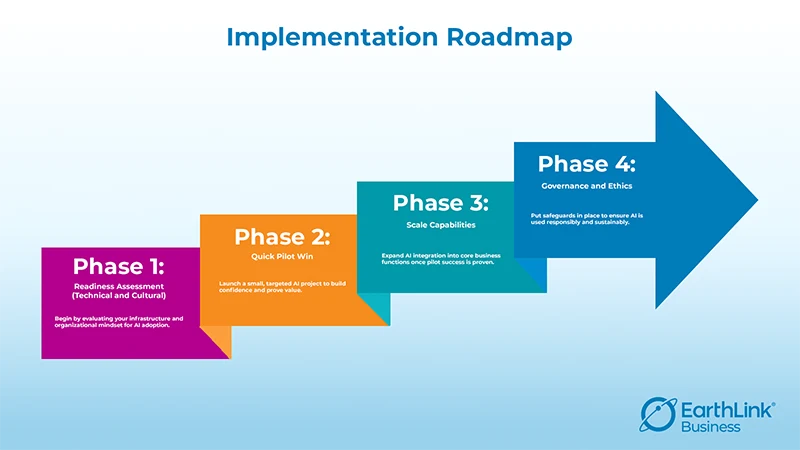
Implementation Roadmap
Adopting AI effectively requires a phased approach that balances readiness, quick wins, scalable integration, and responsible governance. This roadmap ensures your business sees measurable results while maintaining ethical and cultural alignment.
- Phase 1: Readiness Assessment (technical and cultural)
- Begin by evaluating your infrastructure and organizational mindset for AI adoption.
- Review IT systems, data quality, and compatibility for AI solutions.
- Identify skill gaps and gauge workforce readiness.
- Highlight areas where AI could deliver the greatest impact.
- Phase 2: Quick Pilot Win
- Launch a small, targeted AI project to build confidence and prove value.
- Examples include chatbots for customer service or automated expense processing.
- Measure performance, refine the solution, and document outcomes.
- Use results to build internal support for broader AI adoption.
- Phase 3: Scale Capabilities
- Expand AI integration into core business functions once pilot success is proven.
- Embed AI into operations, marketing, finance, HR, and supply chain workflows.
- Standardize processes to ensure consistent performance.
- Continuously optimize models to stay relevant and effective.
- Phase 4: Governance and Ethics
- Put safeguards in place to ensure AI is used responsibly and sustainably.
- Appoint a Chief AI Officer (CAIO) or governance team to oversee initiatives.
- Enforce data privacy, compliance, and ethical standards.
- Maintain transparency, accountability, and explainability in AI decisions.
Emerging Trends and Gaps
Agentic AI and Autonomous Agents: AI is moving beyond generative text to autonomous decision-making systems that can act independently while following business rules. These tools open new possibilities for automation and efficiency.
AI Governance and Chief AI Officers: Leadership now has a voice in AI strategy through governance frameworks and the emerging role of Chief AI Officers. Strong oversight ensures ethical and effective AI deployment.
Sustainability Use Cases: AI is being applied in green logistics, energy demand prediction, and other sustainability initiatives, helping companies reduce their environmental footprint.
SME Affordability and Open Source Tools: Small and medium-sized businesses can access AI through open-source platforms and free tiers. Understanding how to use artificial intelligence in business at lower costs is helping democratize innovation beyond large enterprises.
Regulatory Landscape: Emerging policies like the AI Act and U.S. AI guidelines define compliance standards that businesses must follow, though these regulations are still evolving.
AI FAQs
Is AI too expensive?
Companies must consider the cost of artificial intelligence, but AI investments can yield significant ROI when applied strategically.
How long for ROI?
ROI varies by implementation, industry, and use case, but studies show measurable benefits within months for high-impact deployments.
Will AI replace my team?
AI complements human employees rather than replaces them. It automates repetitive tasks, freeing staff for higher-value work and showing how artificial intelligence helps businesses.
How to start with zero AI experience?
Start small with pilot projects, leverage open-source tools, and educate teams on the most common uses of AI to build confidence and understanding.
Conclusion: AI For Your Business
Key Takeaways
- AI delivers measurable value across marketing, operations, HR, and more. These are among the top benefits of AI in marketing for organizations.
- Understanding the cost of artificial intelligence is critical. While upfront investments can be significant, strategic deployment often results in ROI multiples within months, making AI a financially compelling tool.
- AI complements human teams rather than replacing them. It automates repetitive tasks, enhances productivity, and improves customer and employee experiences, demonstrating how artificial intelligence helps businesses.
- Small-scale pilots and incremental adoption allow companies to test AI effectiveness safely. This approach helps leadership see quick wins while learning how to use artificial intelligence in business without major risk.
- The most common uses of AI include marketing personalization, predictive analytics, customer service automation, operational efficiency, fraud detection, and document processing, providing tangible and scalable benefits across industries.
- Responsible governance and ethics matter. Clear policies, oversight, and workforce training ensure AI is deployed ethically, transparently, and sustainably, reducing risk and maximizing long-term value.
Businesses should weigh AI’s benefits against potential risks. Awareness of the most common uses of AI helps leaders make informed decisions. To take the next step, evaluate your organization’s readiness and consider scheduling a small AI pilot to test effectiveness and gain practical insights.
For guidance on the right tools, check out the top 22 AI tools for small business. For ongoing updates and insights on AI trends, strategy, and implementation, explore the EarthLink Business blog for all things AI.